
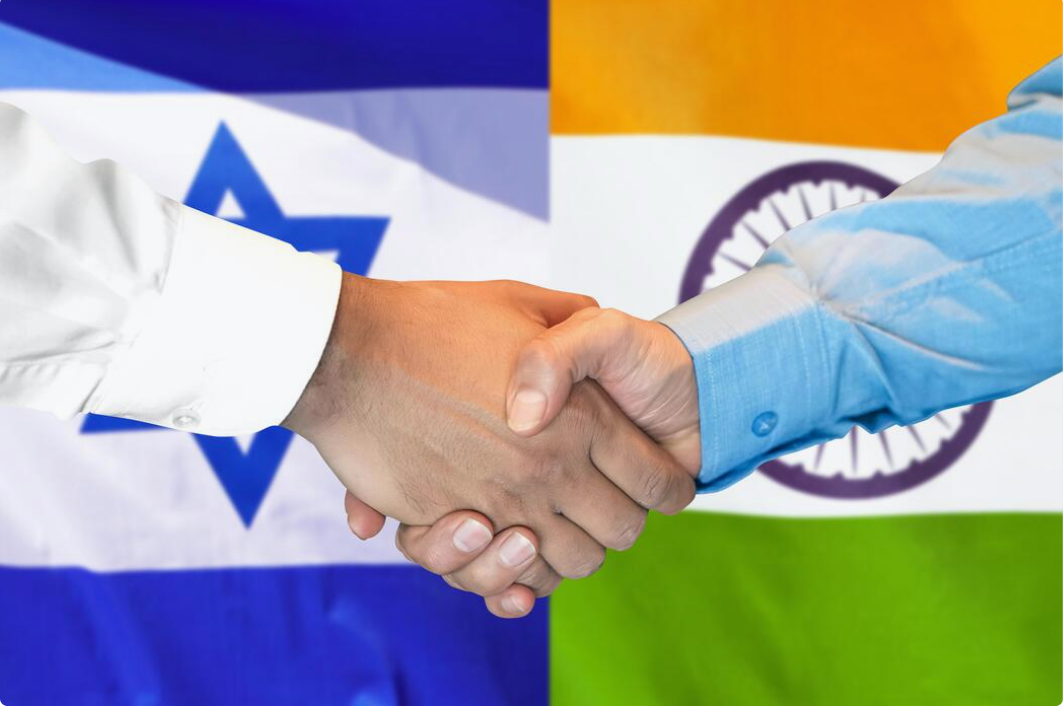
When two best friends meet, protocols and formalities take a backseat. It was evident as Narendra Modi landed at Ben Gurion Airport in Tel Aviv on February 25, 2026. It was his second official visit to Israel as the Prime Minister of India, after 2017. The moment the PM’s plane touched the tarmac and taxied its way onto the red carpet zone, the vibes and signs of bonhomie were omnipresent.
In one of the rarest gestures that broke all diplomatic protocols, both Benjamin Netanyahu and his wife, Sara, were at the airport to welcome Modi. What caught the attention was the color of Sara’s attire. It was saffron from top to bottom, matching it with Modi’s subtle saffron hue in his coat’s pocket. Ironically, saffron is the color of Hindus, who form the majority population in India. And, as usual, it was the “Modi-hug” and an equally warm embrace from “Bibi” Netanyahu that kept cameras rolling.
Table of Contents
Why is this Visit Significant?
The timing of this visit is noteworthy. It comes months before the elections in Israel and days after Trump’s “Board of Peace” optics for Gaza’s restoration after its self-inflicted war damage. The geopolitically untimely visit is an indication of India’s urge to expand the India-Israel Strategic Partnership to new heights.
For decades, the US played the role of a Godfather in the Middle East and West Asia, formulating policies and making key decisions in favor of its allies. However, it now feels the time is ripe to lessen its presence in this region. It is neither economically nor strategically viable to sustain their long-haul operations, except for marketing their war machines.
New power-hungry players are emerging on the scene. Opportunistic Turkey and Saudi Arabia want to portray their regional supremacy, ignoring the legitimate security concerns of Israel. They aspire to a hegemonic stake in the region, unmindful of the strategic repercussions.
Above everything, Netanyahu is feeling internationally isolated, except for the half-hearted support of the US. Modi’s visit comes at a crucial time as Bibi’s global reputation takes a beating due to serious allegations of war crimes, genocide, and an arrest warrant against him and his ex-defense minister, Yoav Gallant. India’s unconditional support at this juncture matters a lot to mitigate the wounds of injustice suffered by Jews. This historic visit proves Jerusalem is not alone. It has mighty India, the new economic and military powerhouse, by its side.
Decades of Military-Technological Partnership
India-Israel defense cooperation is nothing hidden. For years, New Delhi has been buying Israeli military hardware and cutting-edge defense technologies. Radars, precision-guided munitions, air-defense systems, tactical small arms, rockets, missiles, avionics, and military software dominated the billion-dollar deals in the past. This visit aims to broaden the horizon of military sales and joint production. The focus is on a long-term strategic roadmap.
Both countries are eying a jump from traditional domains to technologically infused ecosystems, such as AI, machine learning, drones, and quantum technologies. The signing of more than 15 MoUs in agriculture, Artificial Intelligence, culture, and education speaks of the diversity of collaborations, in addition to military ties. It is a key milestone in the relationship between the two countries.
Some of the new defense systems on offer are Air LORA, Sky Stinger, Rampage, Spice precision-guided bombs, Barak-8 ER missiles, Ice Breaker, Iron Beam, and more. India is never shy to absorb new technologies that make a difference on the battlefield. Israel knows that very well.
Strategic Outcome
The bilateral meeting between Modi and Netanyahu has enormous repercussions in global geopolitics and in India’s neighborhood. The nefarious trio of Pakistan, China, and Turkey is closely watching the visit. The deepening defense cooperation predominantly emphasizes critical technology transfers. India gains access to high-end military technologies that have a game-changing effect.
The visit comes amid the final stages of the Gaza War, as the world is hell-bent on Israel to stop the actions in the Gaza Strip, following the barbaric 7th October massacre of innocent Jews by Hamas Islamic terrorists.
The Modi visit sets a different tone for the India-Israel relationship with outright support for Jerusalem. Previous heads-of-state meetings were shrouded in secrecy without any clear message or joint statements. This time, the Modi government has upped the ante, describing India’s full support for Israel in its war against terror. Meanwhile, India is treading the geo-political path cautiously, without annoying friendly Gulf countries, such as the UAE, Oman, Bahrain, and Kuwait.
Political and Diplomatic Outcome
Modi’s historic visit to Israel is unparalleled in India’s West Asia diplomacy, considering its relations in the Gulf region. His address to the Knesset highlights the government’s priority to a tie that stood the test of time. India has maintained a balanced approach, without taking a biased stand. Its diplomacy rests on the strong pillars of ethics, morals, and dignity without compromising on the country’s interests. The key highlights of Modi’s Knesset speech are as follows:
- Narendra Modi extended firm support to Israel, condemning the October 7th massacre as a “barbaric terrorist attack” against humanity. He stated, “We feel your pain“. “We share your grief”. He also said, “India stands with Israel firmly, with full conviction, in this moment, and beyond”.
- In his opening remarks, Modi started by saying, “I also carry with me the deepest condolences of the people of India for every life lost, and whose world was shattered by the barbaric terrorist attack”. A clear shift from the past, when India hesitated to take sides in the Middle East conflict.
- In a historic address to the parliament or Knesset, Modi did not mince words. He openly supported Jerusalem, saying “no cause can justify the murder of civilians”. He received a standing ovation from the members of the ruling party, including Benjamin Netanyahu, opposition leaders, and the speaker of the Knesset. Furthermore, Bibi reciprocated by describing Modi as “more than a friend, a brother”. He also lauded Indian commandos who valiantly liberated Haifa from the tyrannical Ottoman Empire in the First World War.
- In a historic first, the Indian Prime Minister was conferred with the “Speaker of the Knesset” medal for his unconditional support of Israel. His remarks about the Jewish community in India, especially the Jews of Kerala, Kolkata, and Mumbai, who never experienced any discrimination in India, got a huge applause.
- In a nutshell, Modi’s Knesset speech leaves no room for ambiguity in India and globally that, as long as the right-wing BJP government is in power, India will openly support Israel, come what may. After all, when ideologies match, a natural bond deepens without any catch or clause.
Economic and Cultural Outcome
New Delhi emphasizes continued collaboration in agriculture, defense, AI algorithms, quantum technology, and people-to-people contact. The Indian Prime Minister said, “India is committed to expanding trade with Israel, as both sides are formulating cross-border financial linkages via digital public infrastructure”. He also stated that an ambitious Free Trade Agreement is on the cards to tap the vast potential in bilateral trade and commerce, including science and technology.
India’s bilateral trade has grown significantly from USD200 million in 2002 to a staggering USD10.7 billion in 2022-23, before the Gaza conflict. India exports refined crude oil (petrol and diesel), textiles, gems & jewelry, and heavy machinery to Israel. It imports diamonds, minerals, fertilizers, and electronic circuits.
Lately, talks on seamless labor mobility from India to Israel dominate all economic discussions. Israel is facing an acute labor shortage due to the closure of the border, restricting Palestinians from coming to work in Israel.
Similarly, Indian students and research scientists are eyeing admissions in prestigious Israeli academic institutions. In-coming and outgoing tourists are also on the rise. It is a part of cultural diplomacy that helps strengthen the existing bond.
Bilateral defense trade remains the cornerstone of India-Israel Strategic Partnership, even as the focus is to grow beyond this traditional realm.
Global Reactions and Unwarranted Controversies at Home
The world is watching the developments between New Delhi and Jerusalem with a hawk eye. For instance, rogue adversaries, such as Pakistan and Turkey, are considering this visit as a threat to their sovereignty and existence. They unequivocally consider the brother-in-arms as a danger to the so-called Muslim Ummah (community) of which they are the self-proclaimed caliphates.
Similarly, Saudi Arabia is closely monitoring the unfolding of events during the meeting of the two great leaders. However, Western leaders haven’t spoken openly about this visit.
At home, the Modi government is facing the usual backlash from the pro-Palestinian Congress party, which is the main opposition in the Indian parliament. It calls the visit “shameful” and accuses the Prime Minister of aligning with the US and Israel. This superficial crying and shedding of crocodile tears is not new in their political genome, which, for years after independence, restricted the majority Hindus from freely expressing their religious beliefs.
Other fringe elements, like the extinct communists, fashionista liberals, and ill-educated pseudo-seculars, are criticizing Narendra Modi for his trip to Israel. Everyone knows that such extinct political ideologies try to satisfy the minority Muslims of India in exchange for votes. For them, the minorities are an easy vote bank by showing their stance against Hindus.
India’s western neighbor, Pakistan, is deeply annoyed by this historic visit, as it considers Jews and Hindus to be non-believers who are trying to destabilize the Muslim world. Fear and desperation are clear in the social media posts of a few notable social media influencers in Pakistan.
Highlight of Modi’s Epic Visit
The highlight of Modi’s trip to Israel was a visit to Yad Vashem Holocaust Memorial in Jerusalem. He paid heartfelt tributes to the six million innocent Jews who perished at the hands of the Nazis during the Second World War. It was a somber moment for both the leaders as they walked through the gates of the memorial into the central hall. Modi laid a wreath and placed a stone in memory of the departed souls. The Jews were eliminated systematically between 1939 and 1944 in the scattered ghettos and concentration camps.
- Narendra Modi had Benjamin Netanyahu by his side at the Holocaust Memorial.
- The highlight of the solemn ceremony was the recital of “El Maleh Rahamim” by the Cantor.
- PM Modi placed a wreath in memory of the victims of the Holocaust.
- Modi also paid a visit to the “Hall of Names” that preserves the identities of the numerous Jews who were murdered in cold blood by the Nazis. The memorial preserves the names of nearly 6 million Jews.
- It is the second visit of Narendra Modi to Yad Vashem.
Key Takeaways of this Historic Visit – MoUs and Agreements
- MoU on AI capacity building in civilian sectors and academic research, especially in areas of defense and public-private partnerships.
- MoU on advancing education and data literacy through the use of AI, in areas like human-centered learning and teacher development. In this context, a special MoU was signed between Nalanda University and the Hebrew University of Jerusalem.
- LoI on establishing a joint Cyber Centre of Excellence in India.
- Signing of a Cultural Exchange Program in the creative domain of arts, music, dance, theatre, and other fields.
- Signing of a MoU between ICAR and MASHAV to enhance next-generation agricultural technology development. Another document was signed in cooperation with the fisheries.
- MoU on enhancing geophysical exploration, especially mineral exploration using predictive AI technologies.
Modi’s Interaction with the Indian Diaspora, Artists, and Innovators
Modi’s trip to a foreign nation is not complete without meeting the dynamic Indian diaspora, consisting of university students, scholars, businessmen, artists, and workers who shape a nation. This trip was no different. He met people from all walks of life who are residing in Israel, learning and contributing to the local society. They best reflect the deep-rooted trust, bond, and friendship between the two great nations whose civilizations are thousands of years old. Modi also planted a tree in the President’s Garden.
Conclusion
This historic trip ushers in a new era of regional and global supremacy in an evolving world order. Both leaders agreed on a diverse range of topics, including science & technology, artificial intelligence, virtual reality, agriculture development, and defense co-production. Gone are the days of Western hegemony, as new powers of the Global South are shaping the fragile geopolitics. India is surging ahead in its quest for a leadership role, respecting the interests of its key allies, such as Israel, Russia, France, the EU, BRICS, and the United States of America. Whether people-to-people ties or diplomatic bonhomie, India understands the sentiments and knows how to carry its trusted partners along the path to prosperity.